Panteão NacionalLisbon · Portugal
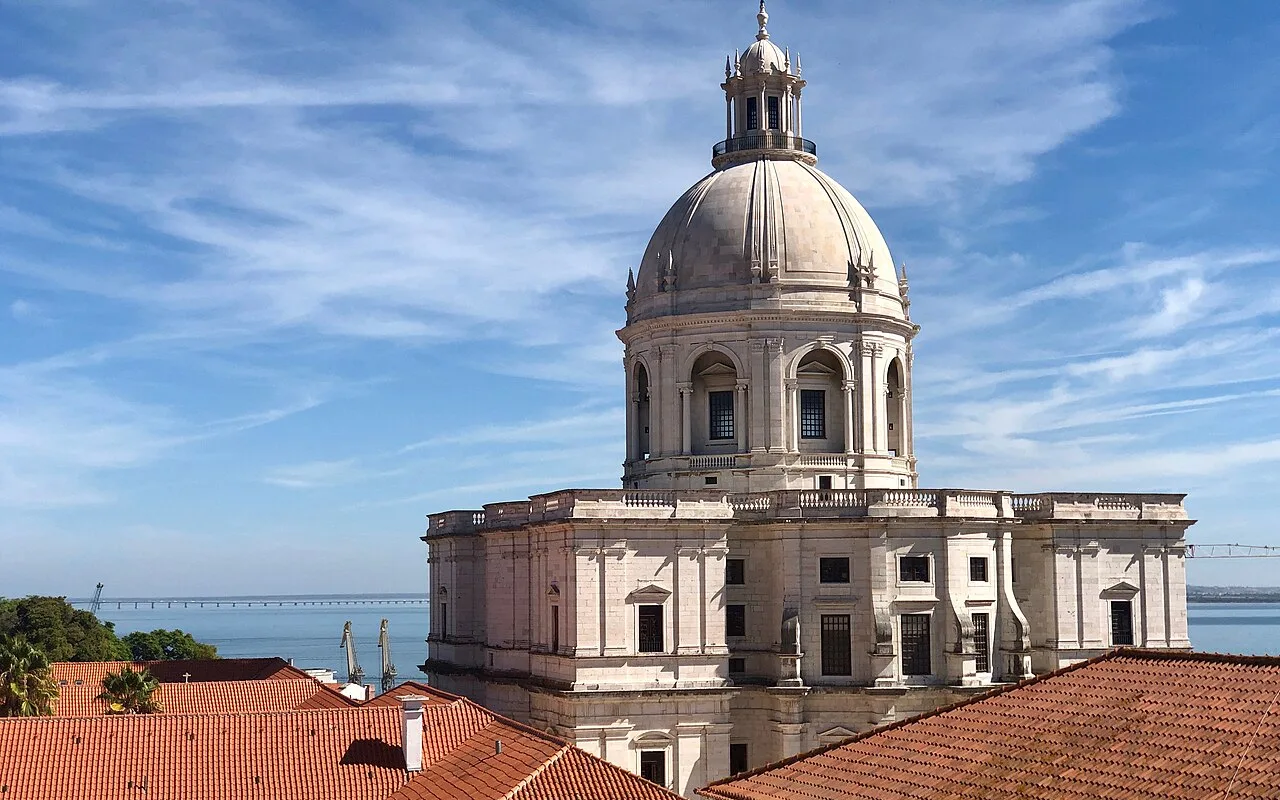
The white dome of the Panteão Nacional rising over the red roofs of Alfama

Santa Engrácia · Campo de Santa Clara

Portugal's poets, its fado queen, and its greatest footballer rest here

A church begun in 1682 and finished in 1966 — so slow that Lisbon still calls any endless job an obra de Santa Engrácia. Inside: Amália, Eusébio, and a terrace over Alfama.

See ticket options From €18
The Baroque facade of the church of Santa Engrácia

One ticket, church and terrace

Entry to the Panteão and its rooftop

Adult ticket

Ages 25+ — or any age without ID

€18

per person · no timed slot

  • Skip-the-line entry to the Panteão Nacional (Igreja de Santa Engrácia)
  • Polychrome-marble nave, cenotaphs and presidential tombs
  • Climb to the rooftop terrace — 360° view over Alfama and the Tagus
  • Mobile ticket — no printing needed
Reserve my adult ticket
360° dome viewRooftop terrace over Alfama, the Tagus and the 25 de Abril Bridge
1682–1966Took 284 years to finish — origin of the Portuguese idiom 'obras de Santa Engrácia'

Closed every Monday. Saturday mornings collide with the Feira da Ladra flea market — atmospheric, but crowded after 11am.

Amália rests hereInterments include Amália Rodrigues, Eusébio, Almeida Garrett, Sophia de Mello Breyner
Alfama addressCampo de Santa Clara — five minutes from the Tram 28 line

Around the crossing

A Greek cross under a white dome

The nave of the Panteão with tombs set in its arms
Tombs in the arms of the cross
Looking up into the dome of the Panteão Nacional
Into the dome
The polychrome marble rosette in the floor of the Panteão
The marble rosette underfoot
The view from the Panteão terrace over Alfama and the Tagus
Alfama and the Tagus from the terrace

The crossingFour arms of equal length, meeting under the dome — the plan the whole building turns around.

Book in your language
Your currency, final price.
Pro tips included
Best times, secret spots, the room most miss.
Ready before you fly
Mobile ticket, ready in your inbox.
24/7 human support
Real people, any hour, any time zone — 24/7, in your own language, right through to your visit day.
The view from the Panteão terrace over Alfama and the Tagus

Up on the roof

The reason to climb the last stair

The Panteão Nacional occupies the seventeenth-century church of Santa Engrácia in the Alfama district of Lisbon, on the Campo de Santa Clara above the Tagus. Begun in 1682 to the design of João Antunes — Portugal's first major baroque architect — the building is laid out as a Greek cross under a vast central dome, faced inside and out with the coloured Portuguese marbles that became a signature of the late seventeenth-century Lisbon school. The original Santa Engrácia parish church on the site had been destroyed by a windstorm in 1681, and the rebuild was conceived from the outset as one of the most ambitious baroque interiors in Portugal.

Two hundred and eighty-four years

The building that gave Portuguese a byword for never finishing

Construction took an extraordinarily long time. The dome remained unfinished through the eighteenth, nineteenth and most of the twentieth century, and the church was only formally completed in 1966, two hundred and eighty-four years after it was begun. The Portuguese language preserves the memory of this delay in the idiom 'obras de Santa Engrácia' — 'works of Santa Engrácia' — used to describe any project that drags on indefinitely. The decree converting Santa Engrácia into the National Pantheon was signed in 1916, and the first interments and cenotaphs followed in the years immediately after. The building has served as Portugal's official memorial church ever since.

The nave of the Panteão with tombs set in its arms

The interments and cenotaphs are the heart of the visit. The empty memorial — a cenotaph — of Luís de Camões, Portugal's epic poet, stands inside the dome despite the fact that his actual remains were lost centuries ago. Real burials include the writers Almeida Garrett and Aquilino Ribeiro; the poet Sophia de Mello Breyner Andresen; Manuel de Arriaga, the first elected President of the Portuguese Republic; the resistance leader Humberto Delgado; the fado singer Amália Rodrigues, interred in 2001 in a ceremony watched by much of the country; and the footballer Eusébio da Silva Ferreira, transferred to the Pantheon in 2015 after his death the previous year.

The gilded organ inside the Panteão Nacional

Sent before you go

Your National Pantheon of Lisbon 5-minute guide

Hand-written, narrated by a heritage host. Five minutes through the church that took 300 years to finish — the cenotaphs of Vasco da Gama and Henry the Navigator, and the tomb of Amalia Rodrigues.

  • Why the work took 284 years, and who finally closed the dome
  • Who is actually buried here — and who only has a cenotaph
  • How Amália Rodrigues and Eusébio came to lie in a 17th-century church
  • The best hour for the terrace, and what you can see from it

Practical

Before you walk up to Campo de Santa Clara

Address

Campo de Santa Clara, 1100-471 Lisboa, Portugal

Hours

Tuesday to Sunday 10:00–17:00 (October to March) / 10:00–18:00 (April to September). Closed Mondays. Annual closures: 1 January, Easter Sunday, 1 May, 13 June (Santo António — Lisbon's patron saint), 24 and 25 December.

Getting there

Tram 28 to Voz do Operário (5-minute walk). Train to Santa Apolónia (10-minute uphill walk through Alfama). Bus 712 or 734 to Voz do Operário. On foot from the Castle of São Jorge: 15 minutes downhill through Alfama. No on-site parking — Alfama is restricted-access.

Time needed

60 to 90 minutes for the standard route: ground-floor nave, cenotaphs and tombs, upper gallery, rooftop terrace.

What to wear

Comfortable shoes — the climb to the dome involves several flights of stairs. The building remains a memorial space; modest dress is appreciated.

Accessibility

Ground floor and main nave are wheelchair accessible. The upper galleries and rooftop terrace are reached by stairs only and are not accessible. Email us before your visit for the current routing.

Read before you go

Five guides to the Panteão

Asked at the door

Questions, answered plainly

What are the opening hours?

Tuesday to Sunday, 10:00 to 17:00 from October through March, and 10:00 to 18:00 from April through September. Closed every Monday — this is the most common planning mistake international visitors make. Also closed on 1 January, Easter Sunday, 1 May, 13 June (Santo António, Lisbon's patron saint feast), and 24 and 25 December. Last entry is normally thirty minutes before the published closing time, and the rooftop terrace tends to close fifteen minutes before the rest of the building so the dome stairs can clear.

Do I need to choose an entry time?

You choose a session rather than a fixed time. The Pantheon sells admission in two windows: a morning session from 10:00 to 14:00, and an afternoon session from 14:00 until closing (18:00 April to September, 17:00 October to March). Pick the one that suits your day at checkout and arrive at any point within it — there is no fixed arrival time, and once inside you may stay until closing. Mornings are the calmer half: the first hour after opening is the quietest of the day, while mid-afternoon brings the tour groups and the longest wait for the rooftop terrace. Last entry is normally thirty minutes before closing.

Where exactly is the Pantheon?

On the Campo de Santa Clara in the upper Alfama district of central Lisbon, ten minutes uphill on foot from the Santa Apolónia train station or a short walk from the Tram 28 stop at Voz do Operário. The address is Campo de Santa Clara, 1100-471 Lisboa. The building is the large white-domed church on the north side of the square. Look for the dome from anywhere in lower Alfama — it is the most prominent landmark in the upper neighbourhood and easy to navigate to on foot.

Is this the same as the Pantheon in Paris?

No. This is the Panteão Nacional of Lisbon, housed in the seventeenth-century Igreja de Santa Engrácia in the Alfama district. The Paris Panthéon is a completely separate eighteenth-century monument on the Left Bank in the Latin Quarter, where Voltaire, Rousseau, Victor Hugo and Marie Curie are buried. The two share a name but no operator, no architecture, and no connection. We book only the Lisbon Pantheon. If you are looking for the Paris monument, the operator there is the site authority.

Who is buried at the National Pantheon?

Real interments include the writers Almeida Garrett and Aquilino Ribeiro; the poet Sophia de Mello Breyner Andresen; Manuel de Arriaga, the first elected President of the Republic; the resistance leader Humberto Delgado; the fado singer Amália Rodrigues, interred in 2001; and the footballer Eusébio, transferred here in 2015. The cenotaph (empty memorial) of Luís de Camões, Portugal's epic poet, also stands inside the dome — his actual remains were lost centuries ago. Several other writers, presidents and cultural figures are honoured with smaller cenotaphs around the nave.

Can I see the view from the dome?

Yes — the climb to the upper galleries and out onto the rooftop terrace at the base of the dome is the highlight of most visits. The 360° panorama takes in the Alfama rooftops, the Tagus estuary, the cruise port, the Castle of São Jorge across the valley, the 25 de Abril Bridge, and the Cristo Rei statue on the south bank. The climb involves several flights of stairs and is not wheelchair accessible. The rooftop normally closes fifteen minutes before the rest of the building, so plan accordingly.

Why did it take so long to finish?

Construction began in 1682 after the previous church on the site was destroyed by a windstorm in 1681. The dome was the most ambitious element and was repeatedly delayed by funding shortages, political turmoil, the 1755 Lisbon earthquake, and the dissolution of the religious orders in 1834. The building was only formally completed in 1966 — two hundred and eighty-four years after it was begun. The Portuguese idiom 'obras de Santa Engrácia' — the works of Santa Engrácia — has been used since the eighteenth century to describe any project that drags on indefinitely.

When did Santa Engrácia become the National Pantheon?

By decree of the Portuguese Republic in 1916. The First Republic had been established in 1910 after the fall of the monarchy, and the new regime sought a single monumental setting in which to honour figures of national cultural and political importance. Santa Engrácia, then still structurally incomplete, was chosen for its scale, its central Lisbon location, and its relatively recent baroque architecture, which was felt to be more suitable for a civic memorial than the medieval churches of the lower city. The first interments and cenotaphs followed in the late 1910s and 1920s.

How long does a visit take?

60 to 90 minutes for the standard route: the polychrome-marble nave on the ground floor, the cenotaphs and presidential tombs, the upper gallery walk, and the climb to the rooftop terrace at the base of the dome. Visitors with a specific interest in Portuguese cultural history — particularly the lives of Amália Rodrigues, Eusébio, or the writers interred here — typically spend longer at the individual tombs. Combine with a coffee on the Campo de Santa Clara and a stroll through Alfama for a comfortable half-day.

Is it closed on Mondays?

Yes — the Panteão Nacional is closed every Monday, in line with the standard Portuguese national-museum convention. This is the single most common mistake international visitors make in planning a Lisbon itinerary. If your only available day is a Monday, swap the Pantheon for the Castle of São Jorge (open daily), the Jerónimos Monastery in Belém (closed Mondays too — check carefully), or simply explore Alfama on foot. We send a Monday reminder to every customer booked for a Sunday or Tuesday adjacent visit, in case dates need to shift.

How do I get there?

The most atmospheric option is Tram 28, the iconic yellow tram that climbs through Alfama — get off at Voz do Operário, then walk five minutes east. Alternatively, take the train to Santa Apolónia (the eastern Lisbon terminus) and walk ten minutes uphill through Alfama; or take bus 712 or 734 to Voz do Operário. On foot from the Castle of São Jorge, the walk down through Alfama takes about fifteen minutes. There is no on-site parking — the Alfama streets are restricted-access and narrow.

What is the Feira da Ladra?

Lisbon's traditional flea market — the name translates roughly as 'Thieves' Fair' — held every Tuesday and Saturday morning on the Campo de Santa Clara immediately outside the Pantheon. Stalls sell everything from antiques and vintage clothing to Portuguese azulejo tiles, old books, vinyl records, and bric-a-brac. It is one of the oldest continuous markets in Lisbon and runs from around 9am to about 6pm. Combining a Pantheon visit with a wander through the Feira on a Saturday morning is one of the classic Alfama half-days, though the area gets crowded after 11am.

Is there a dress code?

The Panteão Nacional is no longer a consecrated church in active liturgical use — it is a civic memorial — but it remains a respectful memorial space, and modest dress is appreciated. There is no formal enforcement at the door. Shoulders covered and shorts that reach the knee is the working standard. Comfortable closed-toe walking shoes are more important than wardrobe formality, because the climb to the rooftop terrace involves several flights of stairs on smooth marble that can be slippery.

Is it wheelchair accessible?

The ground floor and main nave are wheelchair accessible via the main entrance on the Campo de Santa Clara. The upper galleries and the rooftop terrace at the base of the dome are reached by stairs only and are not accessible — there is no lift to the upper levels. Visitors using wheelchairs will see the polychrome-marble interior, the cenotaph of Camões, and the major tombs on the ground floor. Email us before your visit and we will confirm the current accessibility routing with the operator.

Can I take photographs?

Yes, throughout the building including the upper galleries and rooftop terrace, without flash. Tripods, selfie sticks, and external lighting equipment require an advance permit from the operator and are not normally allowed during standard visitor hours. The rooftop terrace at the base of the dome is one of the best photographic vantage points in central Lisbon, particularly in the early morning when the light catches the Alfama rooftops, and again in the late afternoon when the Tagus is backlit and the 25 de Abril Bridge stands in clean profile against the southern sky.

Is it suitable for children?

Yes — the climb to the rooftop terrace works well for children old enough to manage the stairs (roughly age six and up), and the 360° view at the top is genuinely memorable. The ground-floor tombs may interest older children with an interest in Portuguese cultural history; younger children may find the memorial atmosphere a little quiet. Children aged 12 and under enter free with a ticketed adult, and our family bundle covers two adults with their children. A free child ticket is still issued and scanned at the entrance — reply to your confirmation email with your children's ages and we will arrange it at no cost. Allow 45 minutes rather than 90 with younger children.

Is there food on site?

There is no café or restaurant inside the Pantheon. The Campo de Santa Clara immediately outside has several small cafés and tascas serving coffee, pastries and simple Portuguese lunches; the wider Alfama neighbourhood has dozens of restaurants within ten minutes' walk, ranging from traditional fado houses to modern petisco bars. On market days (Tuesdays and Saturdays) the food stalls of the Feira da Ladra serve grilled sausage, bifana sandwiches, and similar street food. We can recommend specific Alfama restaurants on request when you book.

Can I change my visit date?

Yes — email us at least 48 hours before your booked visit and we will rebook to any other open date within the next sixty days at no charge. Inside 48 hours, same-week swaps remain possible if alternative slots exist but cannot be guaranteed. Tickets are not transferable to another name once issued. If a member of your group cannot attend on the day, the remainder of the group can still use their tickets normally; reply to your confirmation email and we will void any unused ticket.

Is there a refund if I can't make it?

Tickets are issued for a specific date and are non-transferable once issued. If your plans change, reply to your confirmation email at least 48 hours before your visit and we will rebook you to any other open date within sixty days at no charge. Refunds are issued in full only in the case of operator-side failure — the building is unexpectedly closed on your date, or a serious access disruption prevents your visit. We genuinely prefer to rebook rather than refund, because a rebook gets you the visit you came for.

What is the Panteão Nacional?

The Panteão Nacional, or National Pantheon of Portugal, is the country's official memorial building, where the Portuguese state honours figures of national cultural and political importance through burial or commemorative cenotaph. It occupies the seventeenth-century church of Santa Engrácia in the Alfama district of Lisbon, set high on the Campo de Santa Clara above the River Tagus. Designed by the architect João Antunes as a Greek-cross plan beneath a vast central dome, and faced inside with brightly coloured Portuguese marbles, it counts among the most ambitious baroque interiors in the country. Begun in 1682, it was only formally completed in 1966 — a 284-year delay that gave Portuguese the idiom "obras de Santa Engrácia" for any project that drags on endlessly. Among those honoured here are the fado singer Amália Rodrigues, the footballer Eusébio, the writer Almeida Garrett, and a cenotaph to the poet Luís de Camões.

How do I get to the Panteão Nacional?

The Panteão Nacional stands on the Campo de Santa Clara in the upper Alfama district of central Lisbon, and is reached most memorably by the historic Tram 28E, the yellow tram that climbs through Alfama and Graça. Leave it near the Voz do Operário stop and walk a few minutes east towards the white dome, which is visible along the way. Bus 734 stops closer still, at Campo de Santa Clara immediately outside the entrance. Alternatively, take a train to Santa Apolónia, the eastern terminus on the Tagus waterfront, and climb roughly ten minutes uphill through the narrow Alfama streets. On foot from the Castle of São Jorge, the walk downhill takes about fifteen minutes. There is no on-site parking — the Alfama lanes are restricted-access and too narrow for visitor cars — so walking, the tram, or a taxi dropping at the square are the practical options.

Can I climb to the rooftop view?

Yes — the climb to the rooftop terrace at the base of the great dome is the highlight of a visit to the National Pantheon, the Baroque church of Santa Engrácia in Lisbon's Alfama. From the upper galleries that ring the dome interior, a final flight of stairs opens onto a circular open-air terrace with a sweeping 360-degree panorama over central Lisbon and the Tagus estuary: the tiled Alfama rooftops, the cruise port, the Castle of São Jorge across the valley, the 25 de Abril Bridge, and the Cristo Rei statue on the south bank. The ascent involves several flights of stairs and is not wheelchair accessible, so wear comfortable closed-toe shoes for the smooth marble steps. The terrace normally closes fifteen minutes before the rest of the building, so climb early in your visit. This viewpoint alone makes the National Pantheon one of Alfama's finest vantage points over the river.

Whose tombs and cenotaphs are inside?

The National Pantheon, in the Baroque church of Santa Engrácia, holds the tombs of notable Portuguese figures alongside symbolic cenotaphs. Real interments include the writers Almeida Garrett, Aquilino Ribeiro and Sophia de Mello Breyner Andresen; the novelist Eça de Queiroz; presidents of the Republic such as Manuel de Arriaga, Teófilo Braga and Óscar Carmona; the fado singer Amália Rodrigues, interred in 2001; and the footballer Eusébio, interred in 2015. Empty cenotaphs honour national heroes whose remains lie elsewhere or were lost: the explorer Vasco da Gama, Henry the Navigator, the epic poet Luís de Camões, Pedro Álvares Cabral and Afonso de Albuquerque. The pairing of a celebrated fado singer with a footballing legend reflects a deliberately broad definition of Portuguese cultural identity. Bilingual panels beside the major tombs explain each figure, making the National Pantheon a compact introduction to the country's writers, statesmen and cultural icons.

What does 'obras de Santa Engrácia' mean?

It is the Portuguese idiom for a project that drags on endlessly — literally 'the works of Santa Engrácia'. The phrase points directly at the building that now houses the National Pantheon, the Baroque domed church of Santa Engrácia in Lisbon's Alfama. The foundation stone was laid in 1682, yet the royal architect João Antunes died in 1712 with the structure still unfinished, and decade after decade passed with no dome and no end in sight. Ordinary Portuguese speakers began invoking the stalled works as shorthand for anything interminable. The great dome was finally completed and the building reinaugurated in 1966 — two hundred and eighty-four years after the first stone — vindicating centuries of jokes. The expression survives in everyday Portuguese today and is still aimed at long-delayed public works across the country. Few monuments carry a linguistic legacy as vivid as the National Pantheon's.

How do I get there from central Lisbon?

The National Pantheon sits on the Campo de Santa Clara in Lisbon's Alfama district, and the most atmospheric approach is the iconic Tram 28: alight at the Voz do Operário stop and walk five minutes east. Alternatively, take a train to Santa Apolónia, the eastern Lisbon terminus, and climb ten minutes uphill through the Alfama lanes; catch bus 712 or 734 to Voz do Operário; or descend fifteen minutes on foot from the Castle of São Jorge through the neighbourhood's stepped streets. There is no on-site parking and the surrounding Alfama streets are restricted-access, so driving is impractical. Taxis and ride-hailing cars drop off directly on the Campo de Santa Clara in front of the entrance. The walk in through Alfama — past tiled façades, miradouros and fado houses — is part of the experience, making the journey to the National Pantheon as rewarding as the monument itself.

Is the building closed on Mondays?

Yes — the National Pantheon, housed in the Baroque church of Santa Engrácia in Lisbon's Alfama, is closed every Monday, following the standard Portuguese national-museum convention shared by the Jerónimos Monastery and most major Lisbon monuments. This is the single most common planning mistake international visitors make. Additional annual closures fall on 1 January, Easter Sunday, 1 May, 13 June — the feast of Santo António, Lisbon's patron saint — and 24 and 25 December. The finest time to visit is soon after the morning opening, when the polychrome-marble nave is quiet and the low eastern light floods the rooftop terrace with its panorama over the Tagus. If your only free day is a Monday, swap the National Pantheon for an open-air Alfama walk, the grounds of the Castle of São Jorge, or a self-guided fado stroll through the Mouraria, and return another morning.

Is the Lisbon Pantheon the same as the Paris Panthéon?

No, they are completely separate monuments that share only a name. The Panteão Nacional of Lisbon is housed in the seventeenth-century Igreja de Santa Engrácia in the Alfama district and contains the remains of figures including Amália Rodrigues, Eusébio and Almeida Garrett. The Paris Panthéon is an eighteenth-century neoclassical monument on the Left Bank in the Latin Quarter, where Voltaire, Rousseau, Victor Hugo, Marie Curie and others are buried. The two buildings have no operator in common, no architectural similarity, and no historical connection. We book only the Lisbon Pantheon; the Paris monument is operated by the site authority.

Is it still a Catholic church?

No — the Panteão Nacional is no longer in active liturgical use as a Catholic church. The building was deconsecrated and converted into a civic memorial space by republican decree in 1916, and has operated as Portugal's official National Pantheon ever since. The interior retains the form and ornament of a baroque church — Greek-cross plan, central dome, polychrome-marble nave — but the role is civic rather than religious. Occasional state ceremonies, transfers of remains, and civic memorials are held inside, but there are no scheduled masses or other regular Catholic services.

Is the Pantheon a UNESCO World Heritage Site?

No. The Panteão Nacional is a Portuguese National Monument but is not on the UNESCO World Heritage List. The Lisbon-area UNESCO inscriptions cover the Belém Tower and the Jerónimos Monastery (jointly inscribed in 1983) in the western Belém district, and the Cultural Landscape of Sintra (inscribed in 1995) up the hill to the north-west. The Pantheon is sometimes confused with these but is administratively, geographically and architecturally separate. It is one of the most architecturally complete late-baroque domed interiors in Iberia and is widely recommended in international guidebooks despite the absence of a UNESCO inscription.

Can I visit the Feira da Ladra on the same trip?

Yes — and the pairing is one of the classic Alfama half-days. The Feira da Ladra flea market runs every Tuesday and Saturday from around 9am to 6pm on the Campo de Santa Clara immediately outside the Pantheon. The best schedule is to visit the Pantheon at the 10:00 opening, finish by 11:30, and then spend an hour wandering the market before peak crowds arrive in the early afternoon. Stalls sell antiques, vintage clothing, old azulejo tiles, vinyl records and bric-a-brac. The food stalls also provide a cheap and atmospheric lunch option directly outside.

Are there guided tours in English?

Pre-booked English-language guided tours of the Panteão Nacional are not part of the standard operator offering but can be arranged on request for groups; our concierge service can coordinate a private English-language guide with sufficient lead time. The standard self-guided route works well for independent visitors: bilingual interpretive panels (Portuguese and English) sit beside each major tomb and the building is small enough to navigate easily without a guide. For travellers with a strong interest in Portuguese cultural history, a printed visitor leaflet in English is available at the ticket office and is more informative than the brief panels.

Can I photograph inside?

Yes, throughout the building including the upper galleries and the rooftop terrace, with flash disabled. Tripods, selfie sticks, and external lighting equipment require an advance permit from the operator and are not normally allowed during standard visitor hours. The rooftop terrace at the base of the dome is one of the best photographic vantage points in central Lisbon, particularly in the early morning when low eastern light catches the Alfama rooftops, and again in the last hour before closing when the western light makes the Tagus glow. Professional photography or filming for commercial use requires advance permission with separate fees.

Where should I eat nearby?

Alfama has dozens of restaurants within ten minutes' walk of the Pantheon, ranging from traditional fado houses to modern petisco bars. For lunch, the small tascas on the Rua de São Tomé and around the Largo das Portas do Sol offer traditional Portuguese country cooking — grilled sardines, bacalhau, hearty soups — at moderate prices. For dinner with fado, several historic fado houses (Clube de Fado, Mesa de Frades, Tasca do Chico) sit nearby and are bookable on the same evening. On market days (Tuesdays and Saturdays) the food stalls of the Feira da Ladra serve cheap grilled sausage and bifana sandwiches.

What's the connection to the Feira da Ladra?

The Feira da Ladra — Lisbon's traditional flea market — has been held continuously on the Campo de Santa Clara, the open square immediately outside the Pantheon, for several centuries. It pre-dates the conversion of Santa Engrácia into the National Pantheon by a long margin and continues every Tuesday and Saturday from around 9am to 6pm. The two are administratively separate but geographically inseparable: visitors emerging from the Pantheon on a market day step directly into hundreds of stalls selling antiques, vintage clothing, old azulejo tiles, vinyl records and bric-a-brac. For many international visitors the pairing is one of the most memorable single Lisbon experiences.

Sources: the site authority — National Pantheon (official site) · Church of Santa Engrácia / Panteão Nacional — Wikipedia · UNESCO World Heritage Centre — Portugal (confirms Panteão Nacional NOT inscribed) · Visit Lisboa — official Lisbon tourism page for the National Pantheon Last reviewed: